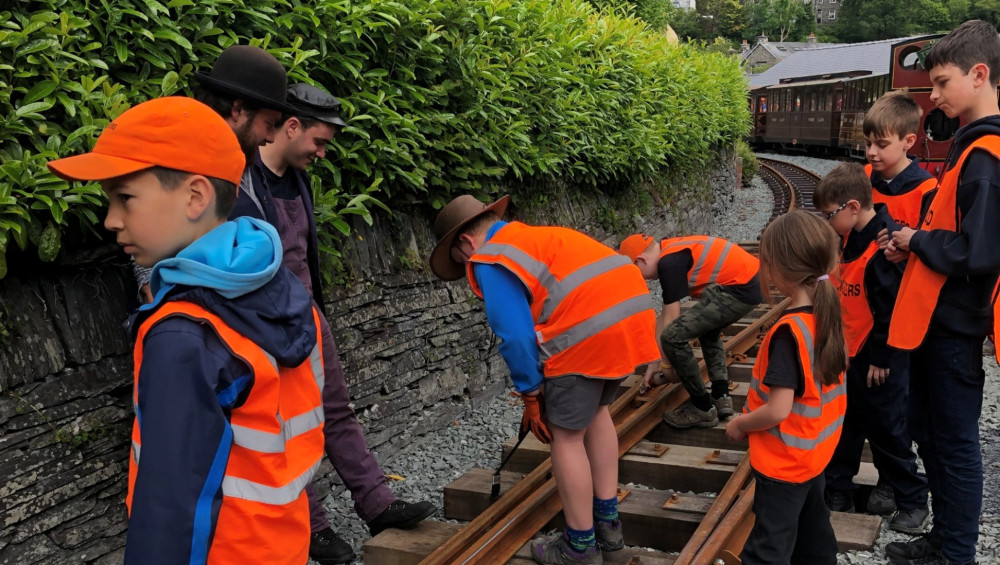
New guidance that finally lays to rest a century-old law that inadvertently made recruiting young heritage railway volunteers illegal, has been released by the Office of Rail and Road.
The new guidance on heritage rail volunteers aged 14-16-years-old gives heritage railways across England, Scotland and Wales total clarity for the first time in the 75-years of the sector. It comes following months of work by the ORR in close partnership with the Heritage Railway Association and Health and Safety Executive.
Tasks such as being involved in the cleaning and preparing of steam locomotives, assisting on station platforms and learning how rolling stock is restored and maintained in a workshop environment should now become more accessible to young people. The guidance applies to all volunteers who are aged between 14-years-old and their minimum school leaving age, which is typically around the age of 16-years-old, but may occur before or after their 16th birthday. The new guidance also provides a full list of tasks considered suitable in line with normal risk assessment processes.
Until an amendment to the Employment Rights BiIl, pushed through the House of Lords by HRA President Lord Faulkner of Worcester and HRA Chairman Lord Parkinson of Whitley Bay, during late 2025, there was a risk that heritage railways could find themselves in legal hot water when encouraging volunteers under the age of 16. The Employment of Women, Young Persons, and Children Act, 1920 came about three decades before the first volunteer-run heritage railway appeared. But in recent years, legal advice has indicated that it could be used to prosecute a railway or tramway that allowed volunteers under 16-years-old.
The successful amendment required in law that the Office for Rail and Road, and the Health and Safety Executive draw up new guidance explaining what sorts of roles it is appropriate for young people to perform when volunteering for a heritage railway. Published today, that guidance now means that young volunteers can look forward to secure training opportunities in heritage rail for decades to come.
Heritage railways and tramways have a long and successful history of training young people who go on to achieve senior positions in the rail industry. Current examples include Tim Shoveller, who is currently Chair of Heavy Haul Rail but began his railway interests as a 14-year-old volunteer platform assistant on the Watercress Line in Hampshire. And Paul Lewin, now General Manager of the UK’s biggest heritage rail operation – the Ffestiniog and Welsh Highland Railways, who started out as a 15-year-old volunteer. But in recent years the existence of the legislative obstacle has severely restricted such opportunities.
Research by the Heritage Railway Association found that half of all heritage railways and tramways in the UK have been unable to offer voluntary opportunities to under-16s because of the outdated legislation. It is estimated that more than 1,500 potential young volunteers have been turned away as a result of the, now gone, legal stance.
Heritage Railway Association Chief Executive, Steve Oates, said: “This is one of the biggest legislative successes that heritage rail has ever seen. We now have a law that specifically facilitates young volunteers being a key part of heritage railways or tramways, and from today guidance from the ORR and HSE that backs that up in a very practical way.
“I started my life in heritage rail as a teenage volunteer on the Isle of Wight Steam Railway. I know that it helped shape my skills for careers in commercial radio and local government as well as heritage rail by helping me grow my confidence at a vital stage.
“It’s frustrating that so many young people haven’t been able to have that boost during their teenage years because of a piece of outdated legislation that was never written with heritage railways or tramways in mind. This is a crucial step forwards for heritage rail, but also for young people and the countless number of organisations who will benefit from their new skills during a long career in rail or elsewhere.”
The new guidance would not have been possible without a longstanding campaign in the House of Commons and House of Lords to push through the changes to employment law needed. That work was spearheaded by the late Geoffrey Claydon, together with HRA President Lord Faulkner of Worcester, and HRA Chair, Lord Parkinson of Whitley Bay.
Lord Parkinson said: “I am delighted that the confusion which has been holding young people back from volunteering on heritage railways and gaining valuable skills and experience has been cleared up. This small but vital change follows ten years of campaigning by the Heritage Railway Association and Lord Faulkner. I pay tribute to them and all the heritage railways and tramways who have provided examples of how the law has been holding them back – and the life-changing opportunities which will now be unlocked.”
Lord Faulkner added: “This is indeed an historic milestone for the HRA and its members, many of whom have been lobbying members of the Commons and the Lords to bring the law up to date. I congratulate them for the part they played in winning this important victory, and I hope it will lead to a surge of interest in heritage railways amongst the thousands of young people who will now be able legally to get involved.”
The new guidance on tasks suitable for young persons aged 14-16 on heritage railways can be downloaded here.
Back